How to Find the Chords of Any Song: By Ear, With Theory, and With AI
Find the key, follow the bass, guess the progression, then check it. A practical method to work out the chords of any song, plus a shortcut when you’re short on time.
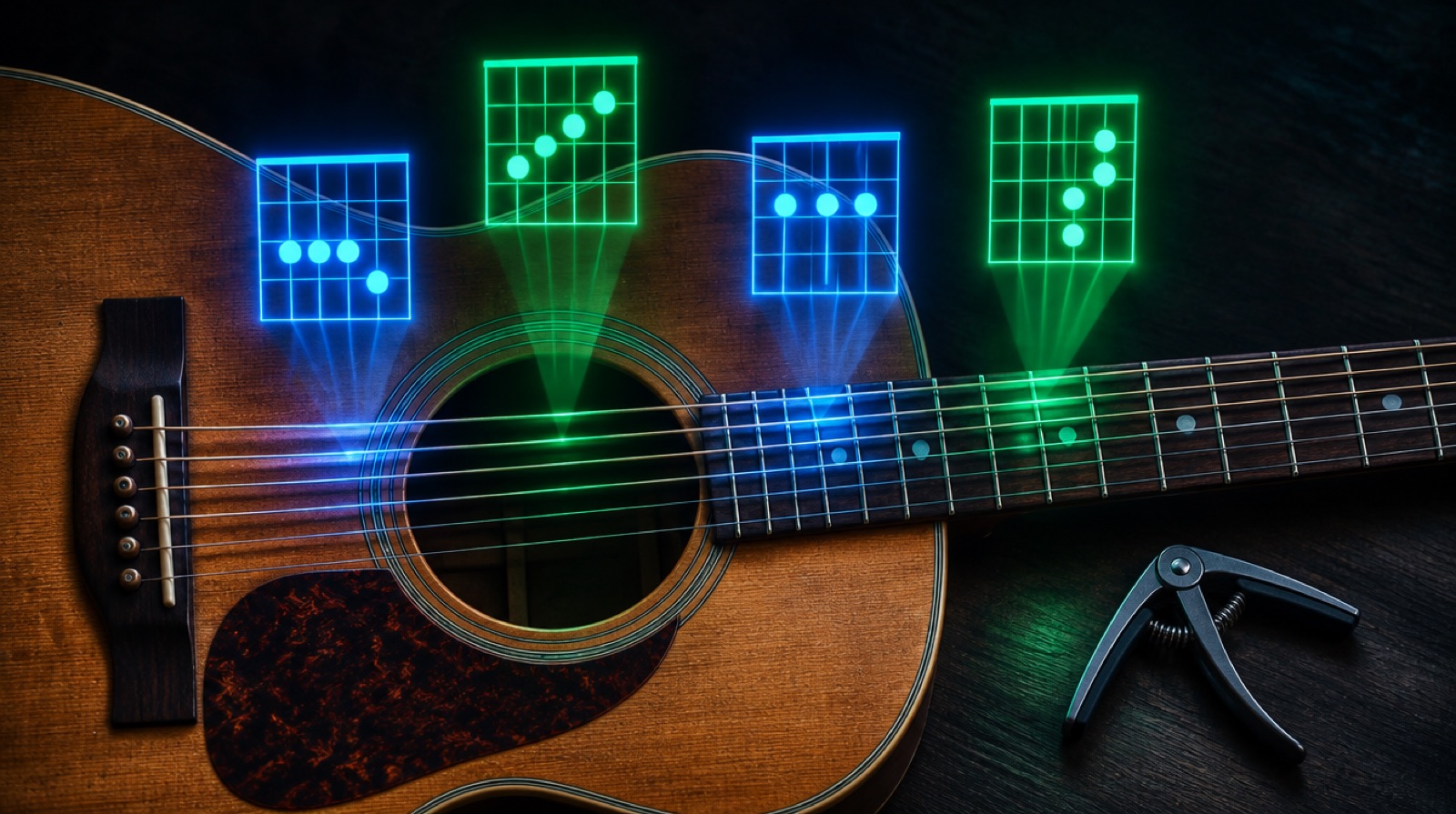
Chord sheets online are a lottery. Some are excellent. Many are in the wrong key, skip the passing chords, or describe a live version instead of the recording you love. Learning to find the chords yourself fixes all of that, and it’s less mysterious than it sounds.
Most popular songs use a small set of chords that follow predictable patterns. Once you know where to look, you can work out a song’s harmony in minutes. Here is the method, step by step, and how to use an AI chord detector to check your work or skip ahead.
Step 1: Find the key
The key is the “home base” of the song: the note and chord everything wants to return to. Finding it first tells you which chords are likely to show up.
- Listen to the very last chord. Most songs end on the tonic, the home chord.
- Hum the resting note. Pause the song in the middle of the chorus and hum the note that feels most settled. Find that note on your instrument.
- Major or minor? Play the major and the minor chord on that note while the song plays. One will blend in; the other will clash. Happy and bright usually means major; darker or sadder usually means minor.
Step 2: Follow the bass line
Here’s the single most useful trick in chord transcription: the bass usually plays the root of the chord. If you can hear the bass note, you’ve found the chord’s name most of the time.
The problem is that bass is hard to hear on laptop speakers and phones. Use headphones, or isolate it: a stem splitter separates the bass from the mix so you hear every note clearly. Then find each bass note on the low strings of your guitar (or the left hand on piano) and write the letters down in order.
Example: if the bass goes G – D – E – C, the chords are probably G, D, Em and C. In the key of G major, E is almost always minor.

Step 3: Use the chords that belong to the key
Every major key has seven chords that “belong” to it, called diatonic chords. They follow the same pattern in every key: major, minor, minor, major, major, minor, diminished. Musicians use Roman numerals to describe them (I, ii, iii, IV, V, vi, vii°).
| Key | I | ii | iii | IV | V | vi |
|---|---|---|---|---|---|---|
| C | C | Dm | Em | F | G | Am |
| G | G | Am | Bm | C | D | Em |
| D | D | Em | F#m | G | A | Bm |
| A | A | Bm | C#m | D | E | F#m |
| E | E | F#m | G#m | A | B | C#m |
Once you know the key, you only have about six likely candidates for each chord. Try them against the song and keep the one that fits.
Step 4: Recognize common progressions
A huge number of songs reuse the same handful of progressions. Learn to recognize them and you’ll often guess an entire verse from two chords.
- I – V – vi – IV (G – D – Em – C): the “four-chord song” behind countless pop and rock hits.
- vi – IV – I – V (Em – C – G – D): the same chords, starting on the minor. Feels more emotional.
- I – IV – V (A – D – E): the backbone of blues, country and classic rock.
- ii – V – I (Am – D – G): the most common move in jazz, and in a lot of soul and R&B.
- I – vi – IV – V (C – Am – F – G): the classic doo-wop and ’50s ballad progression.
When a chord doesn’t fit any of these, it’s often a borrowed chord (like a major IV becoming minor iv) or a secondary dominant (like E7 leading to Am in the key of C). Those are the “spice” chords, and they’re worth noticing because they give a song its character.
Step 5: Listen for the chord color
After the basic major and minor shapes are in place, listen for extensions. They change the mood without changing the root:
- 7 (dominant seventh): bluesy, wants to move somewhere. Very common on the V chord.
- maj7: soft, dreamy, typical in neo soul, bossa nova and lo-fi.
- m7: smooth and mellow minor.
- sus2 / sus4: open and unresolved, neither major nor minor.
- Slash chords (C/G): the chord C with G in the bass. That’s where following the bass line pays off again.
Not sure how to play one of these? Look it up in the chord dictionary.
The shortcut: an AI chord detector
Working out chords by ear is great training, but sometimes you just need the chart for rehearsal tonight. An AI chord detector listens to the recording and labels each chord in time with the music, so you can play along immediately and spend your ear training on the parts that matter.
With Omnes you upload a song (or paste a YouTube link), and you get:
- Chords synced to the original recording, so you see the next change coming.
- A chord diagram for every shape.
- One-tap transposition to any key, to fit your voice or avoid barre chords.
- Slow-down without changing the pitch, to catch fast changes.
Chords are AI-detected, so they’re a fast, solid draft rather than gospel. Use Steps 1–5 above to double-check anything that sounds off, especially passing chords and extensions.
Bonus: changing the key to fit your voice
Found the chords but the song is too high or too low to sing? Move everything by the same number of semitones. For example, moving the four-chord song from G down 2 semitones gives you F – C – Dm – Bb. You can also move the recording itself with a music transposer so you can play along in your new key, or use a capo to keep your open-chord shapes.
Putting it together
- Find the key and whether it’s major or minor.
- Follow the bass to find each root.
- Narrow the options to the chords of the key.
- Match the pattern to a common progression.
- Add the color: sevenths, sus chords, slash chords.
- Check it all against the recording, or get a head start with a chord detector.
The more songs you work out, the faster this gets. After a few dozen, you’ll start hearing progressions on the radio before you even pick up your instrument.
Frequently asked questions
How do I find the chords of a song quickly?
Find the key, follow the bass line to get each chord root, and try the chords that belong to that key. For a faster start, upload the song to an AI chord detector and check the result by ear.
Is there an app that tells you the chords of a song?
Yes. Omnes detects the chords of any song you upload or link from YouTube, shows them in time with the recording with a diagram for each, and lets you change the key.
How do I know if a chord is major or minor?
Play both versions while the song is playing. The right one blends in; the wrong one clashes. Major usually sounds bright, minor darker.
Can I change the chords to a different key?
Yes. Move every chord by the same number of semitones, use a capo, or transpose the chords in one tap in Omnes.